
Case Study
2024 Florida Amendment 4 Disinformation Intervention
A behaviorally-informed campaign designed to disrupt confusion, reduce disinformation impact, and route Floridians to truth in a high-noise environment.
About the Intervention
This intervention involved a combined proactive and reactive search intervention strategy, grounded in real-time behavioral insights from our Early Dawn platform and tailored to the informational needs of Floridians exposed to disinformation narratives.
The Challenge
During the 2024 election, Florida's Amendment 4 faced a massive, coordinated disinformation campaign. Our analysis uncovered a hostile information environment engineered by a network of over 70 state and private entities, including the Governor's administration. They used a sophisticated playbook designed to mislead voters:
Key Opposition Tactics
State-Backed Authority
State agencies used taxpayer funds to launch official-looking websites and run undisclosed ads, lending false credibility to their messaging.
Information Flooding
They overwhelmed search results with more than 25 distinct disinformation narratives, especially targeting topics with religious or emotional framing.
Weaponized "Fact-Checking"
In a cynical move, the opposition created their own biased "fact-check" sites that mirrored legitimate sources to intentionally confuse voters who were trying to verify information.
Our Approach
To cut through the noise, we deployed a proprietary, behavior-first intervention model. Instead of just reacting to keywords, our strategy was to understand and influence the entire information ecosystem.
- We Mapped the Information Journey: Using our proprietary tools, like the Early Dawn platform, we analyzed the full spectrum of online behavior—from media exposure to online discussions—to predict which narratives would spread and identify the specific triggers causing voters to seek information.
- We Deployed Precision Interventions: This deep understanding allowed us to intercept voters at the exact moment of their confusion, delivering a factual, resonant message when it mattered most.
- We Trained the Algorithms: We created and structured high-authority content designed to teach search and social media algorithms to prioritize facts over the opposition's fiction.
Key Results
Our strategic intervention successfully blunted the opposition's impact and changed the digital landscape.
- ✓ Intercepted over 2 million disinformation-related searches.
- ✓ Achieved 4x the industry standard for campaign engagement.
- ✓ Forced the removal of undisclosed, taxpayer-funded ads from Google.
- ✓ Showed a statistically significant correlation between our intervention and a reduction in the opposition's vote margin.
Data: Intervention vs. Vote Margin
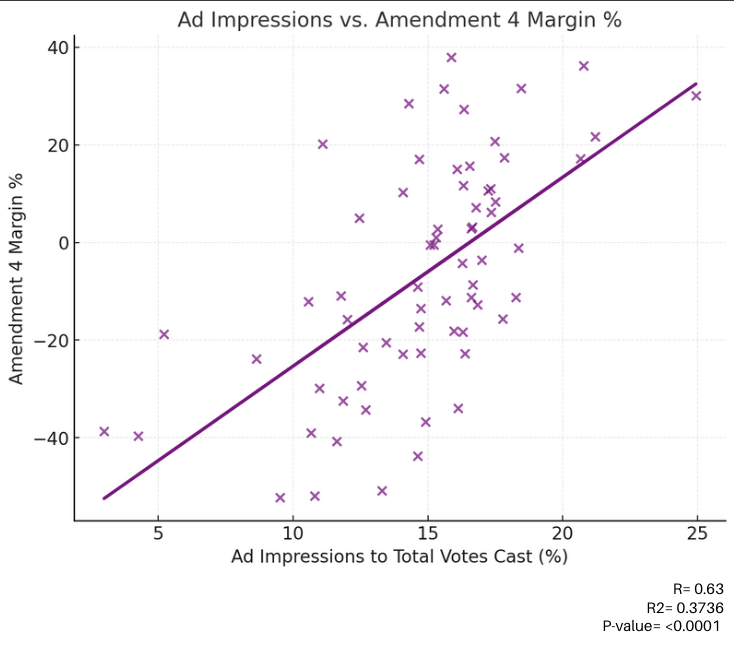
Our analysis showed a direct, positive correlation (R=0.63) between our counter-disinformation efforts and improved "Yes" vote margins. In counties where our interventions were most prominent, the data also showed a corresponding suppressive effect on the "No" vote, effectively reducing the opposition's influence.
Bottom Line
The search-based intervention didn't just fight fire with fire; it redirected fire into informed decision-making. Its success in reaching hundreds of thousands of voters, dismantling algorithmic manipulation, and removing deceptive state-funded ads offers a powerful example of how targeted, real-time strategies can shift the digital terrain in high-stakes electoral environments. This work proves that even the most sophisticated campaigns can be weakened.
Disinformation Is a Strategy.
It Requires a Strategic Defense.
The fight against disinformation can feel overwhelming, but our work in Florida proves that even the most sophisticated campaigns can be weakened and their impact decisively blunted.
Contact Us